Many advertisers are still using revenue as their growth metric. It’s easy to share externally and straightforward to compare the performance of channels and track competitors’ price moves too.
The reality, however, is that business success is not measured by just the top line revenue or profitability. The bottom line is far more critical. If you are doing millions in sales but not making a profit, then you don’t have a viable business. It’s as simple as that.
Margin is frequently one of the trading levers that advertisers can use to win share; they are often very secretive about it. But really there is no secret here. All public traded retailers reveal their margins each quarter and if they are not public, you can read their annual reports in Companies House. If in doubt, you can likely get a good read in your favourite LLM too. So it still surprises me that marketers often find it hard to surface profit data into their campaigns, as this is the difference between success and failure in advertising.
When you feed an advertising system revenue, you are saying revenue is the goal. Whereas with profit you are telling the engine to optimise to profit instead.
This has a huge implication for the success or failure of an advertising campaign.
Here is an example
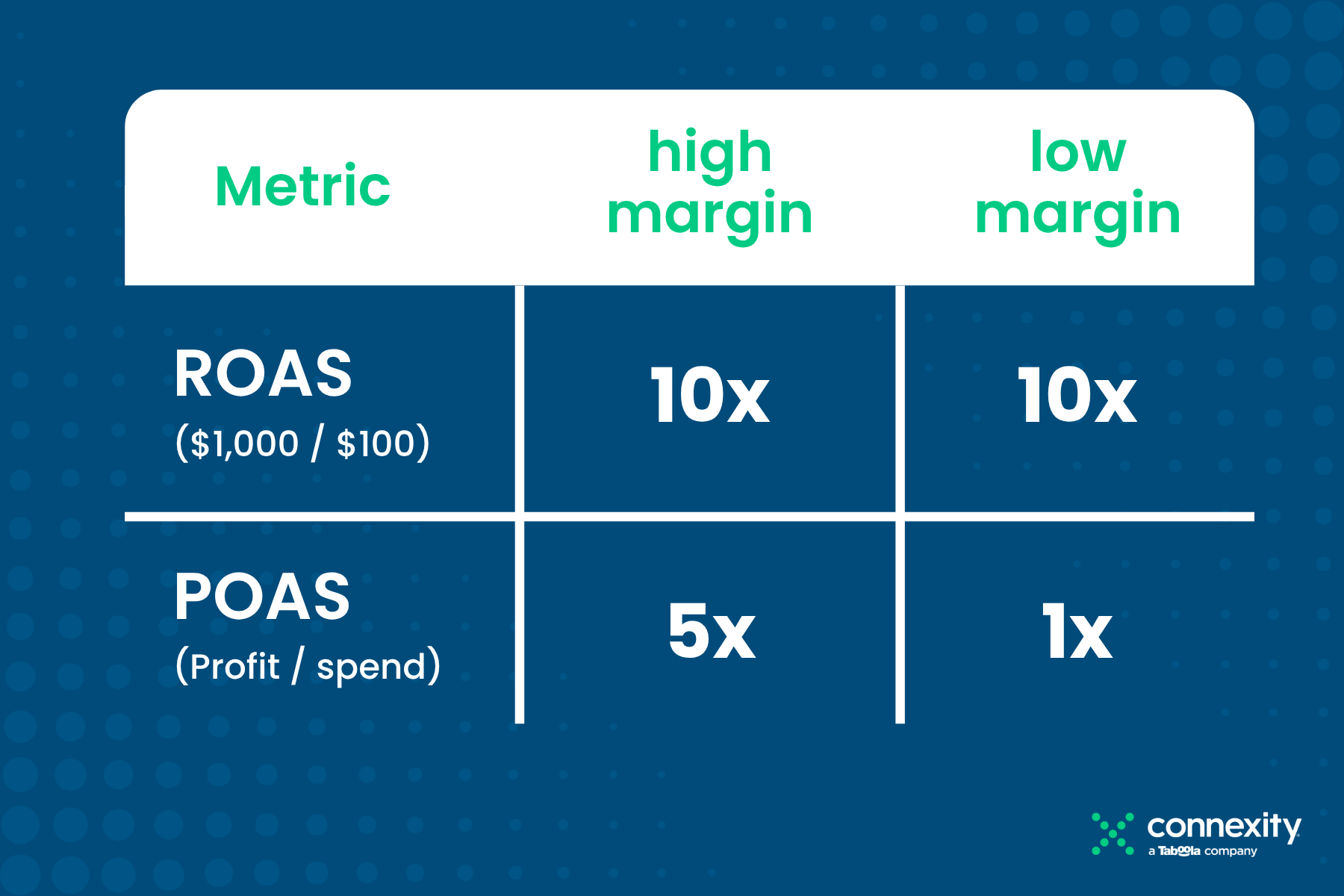
Let’s break down two sofas, both selling for $1,000 with an ad spend of $100.
The Sofa Example
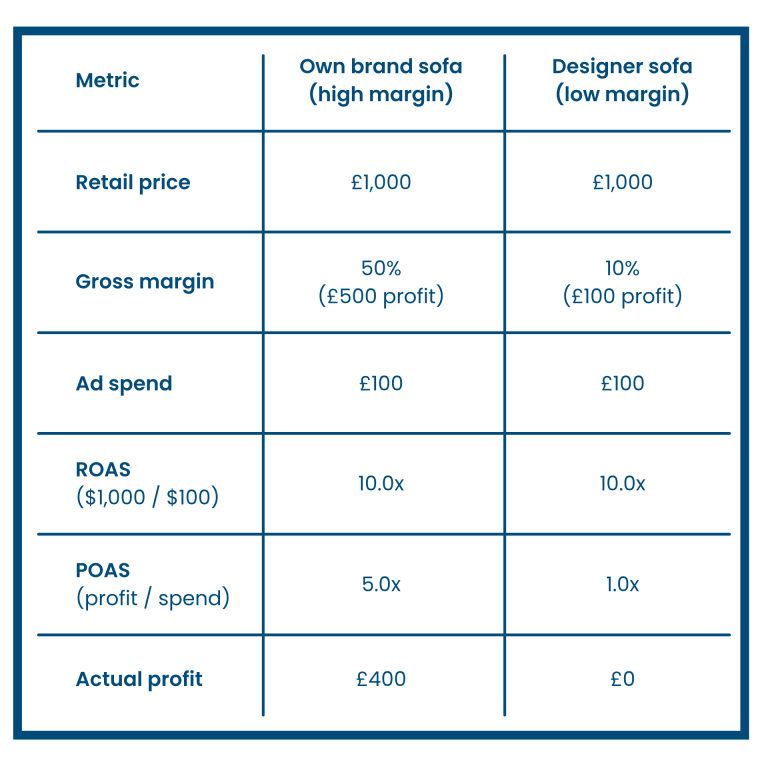
If your team sets a universal ROAS target (e.g., “We need a 10x ROAS to be successful”), both sofas look like a success. However, once you factor in variable margin + credit card fees, shipping, and returns, that 1.0x POAS (break-even) actually becomes a net loss. You are paying for the privilege of selling someone else’s furniture.
Without POAS, your automated bidding algorithms (like Google’s Target ROAS) will treat both sofas equally.
The Danger: The algorithm might find it easier to get sales for the famous “Designer Brand”.
The Result: It pours your budget into the low-margin sofa, scaling your revenue while simultaneously shrinking your actual bank balance.
POAS allows you to level set all the products, regardless of margin level. It allows you to be both more aggressive where it counts, e.g. on your own brand high-margin sofa. It allows you bid lower when you actually make less profits too, eg low-margin designer brands
As a retailer selling brands or a marketplace hosting sellers, POAS tells you exactly where you can beat the competition. If the competition is only using ROAS optimisation, you have the strategic advantage.
There are several ways to make this happen practically. Often POAS is driven by the business model of a retail business. For example, most marketplaces use a POAS goal as a proxy for the commission they earn from the seller.
(Seller commission) / (Ad spend) typically provides the POAS outcome of a marketplace campaign.
For retailers, simply passing the profit per transaction instead of the shopper’s total basket value is the ideal setup in working with POAS, but even in 2026 this setup still eludes many marketers. One solution in this case is to use the product feed to highlight the level of profitability and for the CSS to segment accordingly.
So, if you are not surfacing profit data to your CSS, perhaps it’s time to rethink that before your competitors do.