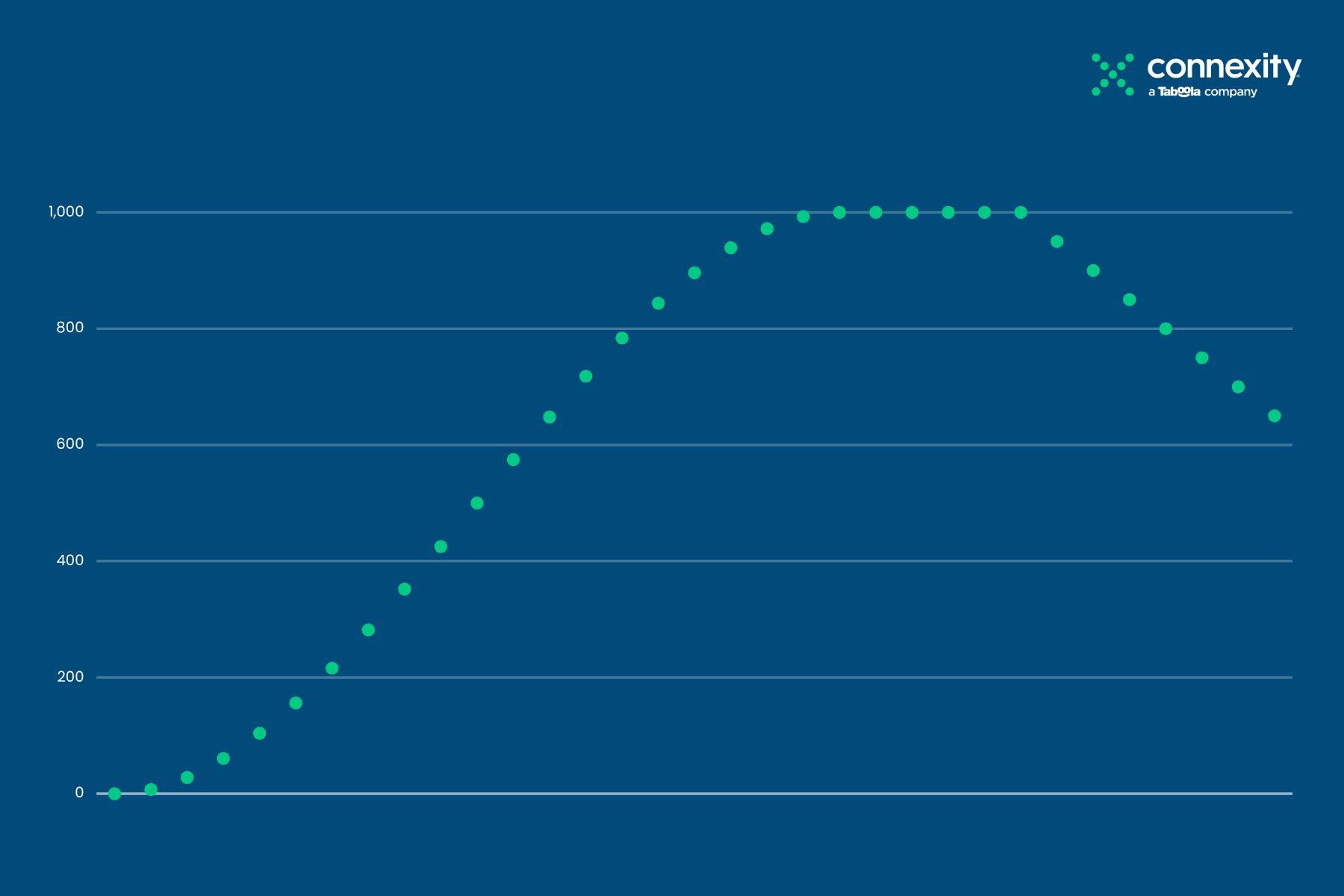
In the world of biddable media, advertisers often hit a “performance peak” when they increase investment to capture a larger auction share. This is the point of maximum ROI for a given monthly or daily spend.
The problem is that if they want more volume beyond this level (and who doesn’t) , the cost per click for each incremental visit costs more, as the auction requires higher bids. Because the conversion rate starts to plateau, the ROI for the advertiser past the performance peak then starts declining.
In short, the more you invest, the less you get back.
If the advertiser keeps investing, they soon hit a breakeven ROI and cannot spend anymore, as each click bought beyond this point becomes unprofitable.
If the advertiser’s main performance channel can no longer support growth, the advertiser needs to find other channels. However, most other channels have lower intent and so convert worse than Google Shopping.
The good news is there is a solution to this conundrum. When an advertiser hits the performance peak, adding an incremental CSS partner like Connexity can make a big difference.
Connexity is completely separate and complementary to the existing activity an advertiser runs in-house or through their agency. Through our Connexity Google Merchant Centre, we run incremental shopping campaigns. Importantly, in the auction Google treats both campaigns as the same advertiser; there is no cannibalisation effect between the Connexity campaign and the main campaign run by the advertiser.
The Google auction mechanics in this case are that:
“A merchant will never be second-priced against itself in the auction for any offer, irrespective of the number, or identity, of the CSSs used by the merchant. Therefore, if two CSSs place bids on behalf of the same merchant, the winning offer and the price paid by the winning CSS will be the same as if those bids had been placed by the same CSS.”*
This means that the Connexity campaign is incremental and generates extra impression share at the expense of competitors.
Typically the Connexity campaign can generate around 25% incremental impression share, assuming the same source of truth, for example GA4, and the same goal is applied to both campaigns. This allows the advertiser to extend the performance peak for 20-30% more investment, leading to significantly more market share, traffic and revenue as a result.
We believe this is the essence of why an extra CSS present in the auction drives incremental impression share that’s not possible from the advertiser themselves.
In simpler terms, advertisers who adopt this incremental CSS strategy will win more market share than those that do not. Those who take it to the next level and align with the internal paid team’s measurement stack and KPIs will truly see how impactful this strategy can be.
Talk to Connexity to get your free growth forecast.