Default tracking of Comparison Shopping Services (CSS) via third-party affiliate systems using last-click attribution, creates significant reporting discrepancies that complicate performance measurement. The clash becomes apparent where advertisers leverage deduplication logic and multi-touch or data-driven attribution models to accurately allocate conversion value across the customer journey.
The problem spans payment, efficiency and scale (or lack of). Estimates on the size of discrepancies and inflation vary, but where they go unnoticed, CSS partners tracked via affiliate attribution can be highly overpaid, creating bloated costs and internal reputational risks. Conversely, if spotted, CSS partners find their commissions paid down, based on a misleading tracking premise and overall under-optimisation of the channel.
As a result, the channel becomes undervalued and under-optimised.
So what does a best-in-class CSS measurement look like?
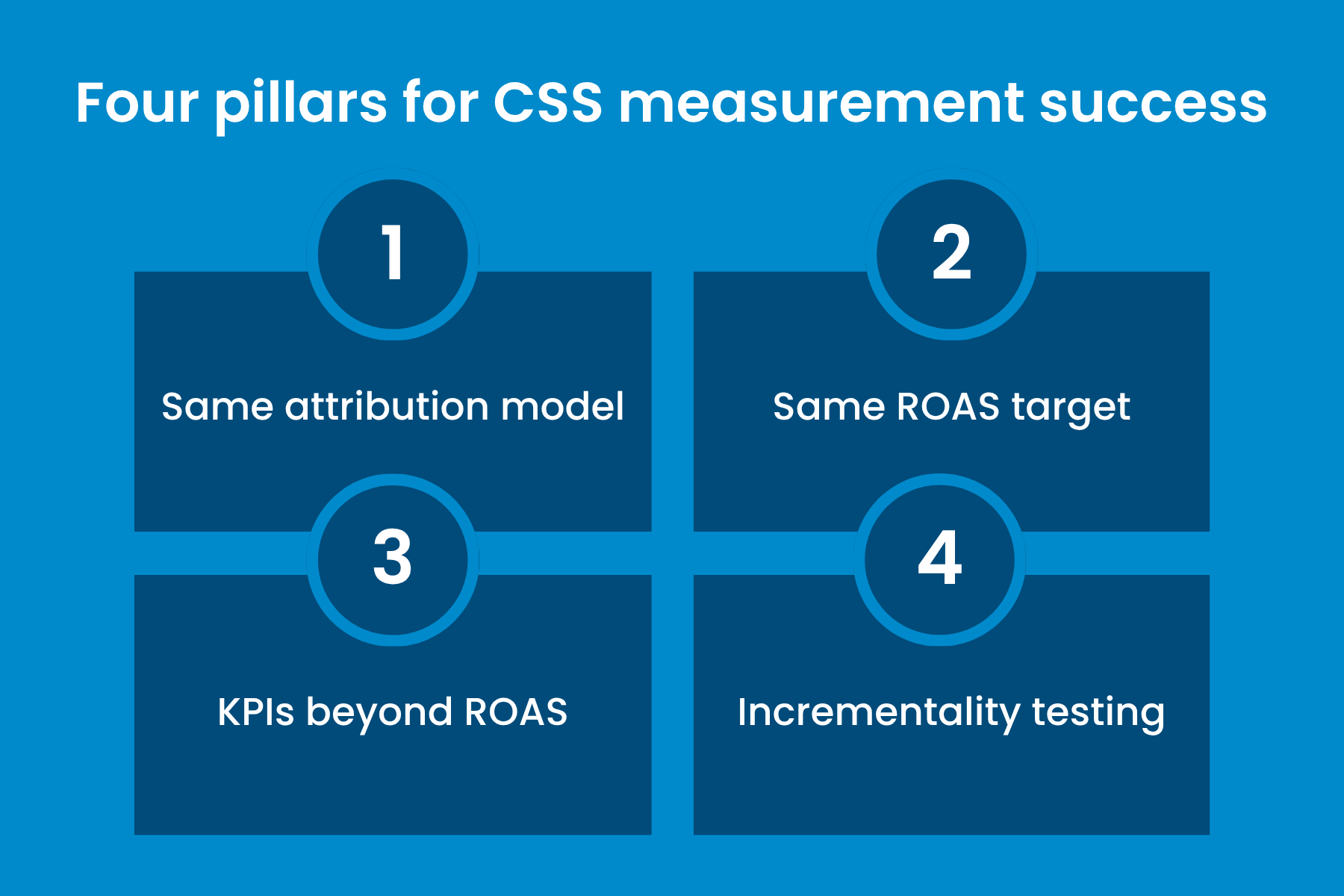
With the right setup and approach, CSS can be the true powerhouse of your strategy and drive new growth. True alignment with your CSS partner involves four pillars for measurement success
Use the same attribution model as the in-house PPC teams.
This approach leads to trust in the numbers and allows for maximum scale, as target flexibility is easier to agree on when you are on the same playing field.
Use the same target
By aligning with the same target as the in-house PPC team, a true comparison of the impact of the CSS can be made.
In testing, advertisers should also recognise several factors influencing CSS performance:
– CSS will have a very weak Google history compared to your in-house team, meaning they typically appear below your own ads in the search result ad depth.
– As CSS will commonly play second fiddle to the direct campaign, it must factor in a margin on top of the bids getting paid.
– When a brand insists on removing brand terms, the target should be aligned with the team’s goal for non-brand activity rather than the combined ROAS for brand and non-brand.
Consider KPIs beyond ROAS
Leverage custom_labels in campaigns to support segmentation. This helps understand the advertiser’s business in new ways, beyond ROAS performance, across other metrics including lifetime value, new customer rate, margin, and stock levels.
Taken together these four pillars can deliver best-in-class CSS measurement and open the door to further sophistication too.
Incrementality testing
Using the same data also makes it far easier to test the incrementality of the CSS too.
If you have different attribution models and targets, this makes it almost impossible to run these types of tests. Our clients can take advantage of our A/B geo-split test methodology to prove the incrementality of Connexity campaigns.
When was the last time you measured affiliate CSS sales against your internal data? Or have you already spotted the gap, reduced commissions and wondered why your CSSs are no longer scaling? Either way, measuring CSS properly with the same models is the core foundation for this strategy. Getting this right can set you on course for large-scale success that you, your boss and the CFO can all believe in.