
Many marketers are measuring CSS using third-party affiliate systems, operating with post-click pixels integrated on the advertiser site. If any affiliate clicks are involved in a conversion, then the affiliate tech will claim credit for one of their publishers on a last-click basis. This is affiliate 101.
However, most advertisers use very different internal systems, which automatically deduplicate sales between channels and so will normally set affiliate sales to pending till they have worked out which to pay and which to delete.
Beyond splitting sales between channels, advertisers also use different models to allocate value through the customer journey, such as Data-Driven or Multi-Touch attribution models. Instead of awarding the entire conversion to one channel, they split the value equally (linear) or have a stronger weighting on different parts of the conversion journey e.g. the first click that started the journey or the last click that initiated the conversion.
When thinking about CSS tracking via affiliate programmes with a post-click pixel, there is a clear problem. Firstly for the CSS. As a business buying traffic from Google before any sales are tracked, if the CSS doesn’t get allocated a sales commission that they were expecting, the arbitrage fails and the CSS will lose money fast after deduplication as they still need to pay Google invoices.
If the advertiser is also using DDA (the default model in GA4) even if the affiliate channel is selected for attribution, they may only get a fraction of the expected revenue with the other portions attributed to other channels. In all cases the difference in revenue will be significant. CSS have to bake in these reductions to their bids, creating a buffer in the auction to reduce the loss risks. Anecdotally, we hear the discrepancy vs GA4 is typically around 50%. I.e., the affiliate tech tracks 50% more.
For advertisers the problem faced sits with payment, efficiency and scale (or lack of).
CSS partners tracking via affiliate tech can then be highly overpaid if the discrepancy goes unnoticed, creating bloated costs and internal reputational risks. Conversely, if the discrepancy is spotted, the commission paid to CSS partners is typically pulled down significantly. As a result, the channel becomes undervalued and under-optimised. No-one wins.
The real risk here is that advertisers can be misled into thinking this is the only value that can be created from CSS and move on to other strategies for growth. However, the reality is that an underoptimised CSS channel working with the wrong data set and the wrong team was set to fail from the outset.
So what does a best-in-class CSS measurement look like?
With the right setup and approach, CSS can be the true powerhouse of your strategy and drive new growth. True alignment with your CSS partner involves four pillars for measurement success
Use the same attribution model as the in-house PPC teams
By utilising the same “source of truth” as their own shopping campaigns—in some cases, GA4, but also other attribution or finance systems operate equally well too. This approach leads to trust in the numbers and allows for maximum scale, as target flexibility is easier to agree on when you are on the same playing field.
Use the same target
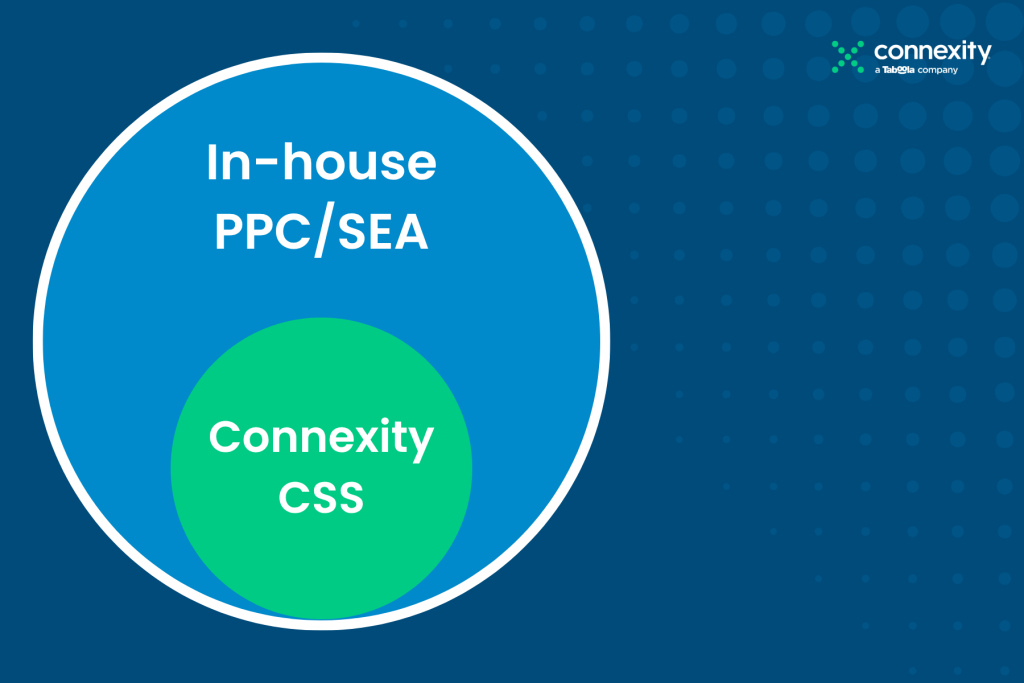
By aligning with the same target as the in-house PPC team, a true comparison of the impact of the CSS can be made. Importantly, as the CSS has a very weak Google history compared to your in-house team, it will typically always appear below your ads in the search result ad depth. Beyond this, a CSS must factor in a margin on top of the bids getting paid. This means we are always playing second fiddle to the direct campaign. It is important to note that when working with a brand and the brand insists on removing brand terms, the target should be aligned with the team’s goal for non-brand activity rather than the combined ROAS for brand and non-brand.
Consider KPIs beyond ROAS
I am writing a dedicated blog on this topic, but as a taster we now use a lot of custom_labels in our campaigns to support segmentation. This helps us understand the advertiser’s business in new ways. It’s not always about the ROAS performance but also the other metrics we can drive beyond that, eg LTV, NCR, Margin, stock levels, etc.
Incrementality testing
Using the same data also makes it far easier to test the incrementality of the CSS too. We have an A/B geo-split test methodology that we use to prove what we do is incremental. If you have different attribution models and targets, this makes it almost impossible to run these types of tests.
So finally, when was the last time you measured the affiliate CSS sales vs your internal data?. Or have you already spotted the gap, reduced commissions and wondered why your CSSs are no longer scaling? Either way, measuring CSS properly with the same models is the core foundation for this strategy. Getting this right can set you on course for large-scale success that you, your boss and the CFO can all believe in.