
Will consumers spend less because of anxiety stirred by the 2026 midterm elections? Could the results alter spending ahead of Cyber Five? Election Day blankets the news with stress and unpredictability, and brings economic opinions to the forefront, but America’s shopping tendencies aren’t nearly as fickle as its votes.
In the realm of retail and e-commerce, the polls are misleading … and that’s a good thing.
Let’s quickly break down the forces at play, what the data says about the ripple effects, and why retailers and publishers targeting a big holiday sales season don’t need to stress.
Consumer sentiment, especially of the negative variety, is often touted around elections …
Sentiment polls are touted as election indicators, and voters whose favored candidates or parties lose frequently respond more negatively about their economic outlook and spending plans.
… but sentiment has little or nothing to do with actual retail spending.
Especially since the pandemic, the sentiment surveys that tend to sow commercial worries — especially around elections, when polls highlight opinions of the economy as voting indicators — have become increasingly detached from actual shopping behavior.
Here’s the Federal Reserve summarizing findings from a study that directly linked survey respondents to their verified retail activity.
Taken together, we show that what consumers have been saying differs from what they have been doing during the post-pandemic period; consumers say they feel worse, but through the end of 2024, they are buying more – not just spending more – than they did in 2019.
Here’s another telling summary of how consumer confidence surveying compared to spending just last month:
The Conference Board’s consumer confidence index fell 6.7 points in September to 81.9, its lowest level since 2014. The next day, the government reported that spending rose 0.9% in August while personal income rose 0.2%.
Here’s a graph from a University of Michigan study documenting the disconnect.
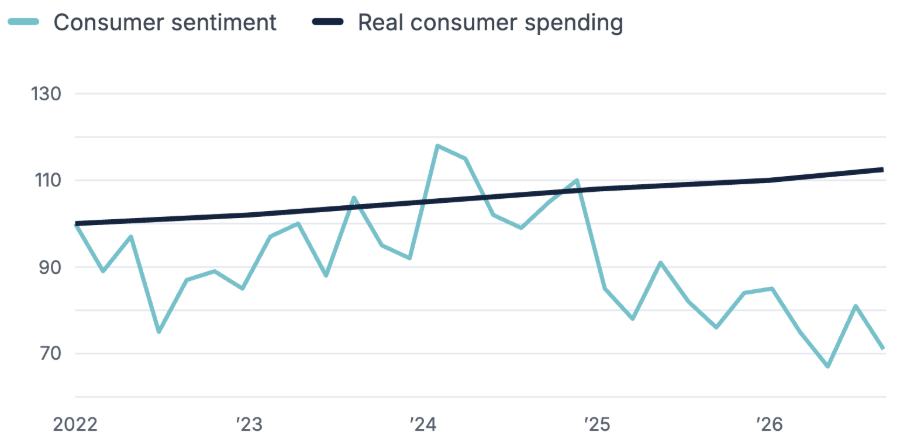
Election retail impact doesn’t show up in the data
Most likely, no. There might be a delay in making decisions and purchases, more commonly documented in larger items like houses and cars, but the overall spend amount for online retail has no discernible connection to elections or election results.
Skimlinks and Connexity data shows no pattern around elections. Performance during and after recent elections has followed the pattern of that year’s Q4 results as a whole.
“While anecdotally it has been suggested that uncertainty around elections causes shoppers to curtail their spending,” a professor of marketing and consumer behavior wrote, “there appears to be very little evidence either domestically or globally to support the claim that an election campaign will negatively impact consumer spending.”
To the extent there’s any observed effect from elections, it is more akin to a holiday- or weather-related disruption of daily routines than a large-scale economic shift.
“There is a two-day hangover effect from elections; in the last election e-commerce went down but rebounded on the third day,” EMarketer research concluded in 2020. Forbes reported online shoppers dramatically cut back their spending around November 1 through November 14 during the 2016 election, a more seismic presidential cycle, but even that November’s online sales rebounded, ending up over 16.3%. Holiday sales for November and December of 2016 were up 4.4%.
So could consumers be distracted for a couple days? Yes. Or they could seek to distract themselves with a little shopping.